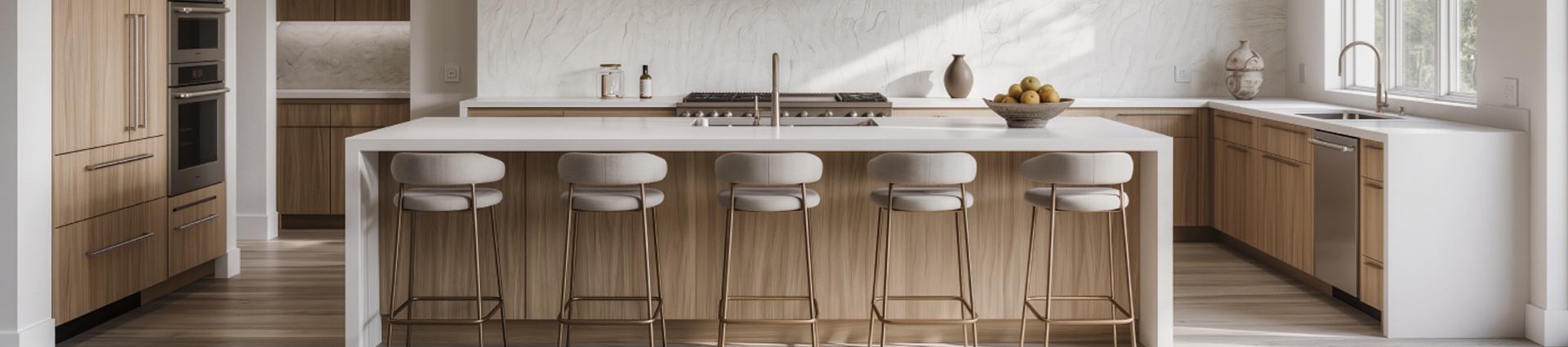
Kitchen islands have become one of the most active areas in modern homes. They are no longer just for food preparation. They serve as dining spots, social spaces, and even temporary workstations. Because of this, selecting the right bar stools is not only about matching style, but also about ensuring comfort, proportion, and long-term usability. A clear kitchen island seating guide helps avoid common mistakes and improves overall user experience.
The first step in choosing bar stools is aligning the seat height with the kitchen island height. Incorrect height leads to discomfort quickly, especially when users sit for extended periods.
Industry standards suggest that the gap between the seat and the countertop should be around 25 to 30 cm. This allows enough legroom while maintaining a natural sitting posture. For most residential kitchens:
Counter height: 90–95 cm
Recommended seat height: 60–65 cm
Bar height: 100–105 cm
Recommended seat height: 70–75 cm
The National Kitchen and Bath Association indicates that proper seating height alignment improves comfort and usability in daily kitchen activities. When selecting a kitchen island high chair, maintaining this proportion is essential to avoid knee pressure and awkward posture.
Spacing between stools is often overlooked in residential layouts. When stools are placed too close together, movement becomes restricted and the space feels crowded.
A practical guideline is to allow at least 50 to 60 cm of width per seat. This gives enough room for users to sit comfortably and move in and out without interference. For family kitchens, slightly wider spacing improves flexibility, especially when different body sizes are involved.
Seat width and depth should also match typical ergonomic ranges. Research from Cornell University shows that seat depth around 41 to 43 cm supports the thighs effectively while preventing pressure behind the knees. This is particularly important for island seating where users may stay longer during meals or conversations.
The choice between stools with backs and without backs depends on how the kitchen island is used.
island stools with backs provide better support for longer sitting sessions. They help maintain posture and reduce fatigue, making them suitable for dining or extended social use. Backrests also create a more complete seating experience, similar to Dining Chairs.
Backless stools, on the other hand, are more compact and easier to store under the island. They are ideal for smaller kitchens where space efficiency is a priority. However, they may not offer the same level of comfort for prolonged use.
In many residential projects, a combination approach works well. Stools with backs can be used on main seating sides, while backless options are placed where space is limited.
Foot support plays a critical role in bar stool comfort. Without a proper footrest, users tend to hang their legs, which quickly leads to fatigue.
OSHA seating recommendations highlight that proper foot support helps reduce pressure on the lower body and improves overall sitting stability. For bar stools, the footrest should be positioned so that the knees bend naturally, allowing the feet to rest comfortably without strain.
A strong and well-positioned footrest also adds to the structural stability of the stool. This is especially important in daily home use where frequent movement occurs.
Material selection influences both comfort and durability. Upholstered seats provide a softer sitting experience and are more suitable for longer use. Foam density should be balanced to ensure both support and resilience.
Hard surfaces such as wood or metal may be easier to clean and maintain, but they can feel less comfortable over time. For residential kitchens where stools are used frequently, padded seating often delivers better user satisfaction.
In swivel designs, smooth rotation enhances flexibility and ease of use. However, the mechanism must remain stable and quiet to maintain comfort during daily use.
| Factor | Recommended Range | Benefit |
|---|---|---|
| Seat height gap | 25–30 cm below countertop | Ensures natural sitting posture |
| Seat width per person | 50–60 cm | Provides comfortable spacing |
| Seat depth | 41–43 cm | Supports thighs properly |
| Footrest position | Matches leg bend angle | Reduces fatigue |
| Backrest option | With or without | Adapts to usage needs |
These values are widely used in kitchen planning and seating design, helping create a balanced and comfortable environment.
Beyond dimensions and materials, structural quality determines whether the stool maintains its performance over time. A strong internal frame, stable base, and reliable joints prevent wobbling and noise.
Meet U Furniture, located in Longjiang, Shunde, operates within a mature furniture manufacturing cluster. This environment supports precise production control, material consistency, and efficient design refinement. By focusing on structural reliability and ergonomic alignment, the company ensures that each product performs consistently in residential settings.
Choosing bar stools is not just about filling a space. It is about understanding how people interact with the kitchen island every day. Whether it is quick meals, family gatherings, or casual work, the stool must adapt to different scenarios.
A well-planned selection using a clear kitchen island seating guide ensures that comfort, proportion, and durability are aligned. From selecting the right kitchen island high chair height to deciding on island stools with backs, every detail contributes to a better overall experience.
When structure, ergonomics, and daily usage are considered together, the result is a seating solution that feels natural, stable, and suitable for long-term use.
Share models, materials, quantity and timeline. We reply within 24 hours.


Monday - Friday: 9:00 AM - 6:00 PM (CST)
Saturday: 9:00 AM - 12:00 PM
Sunday: Closed