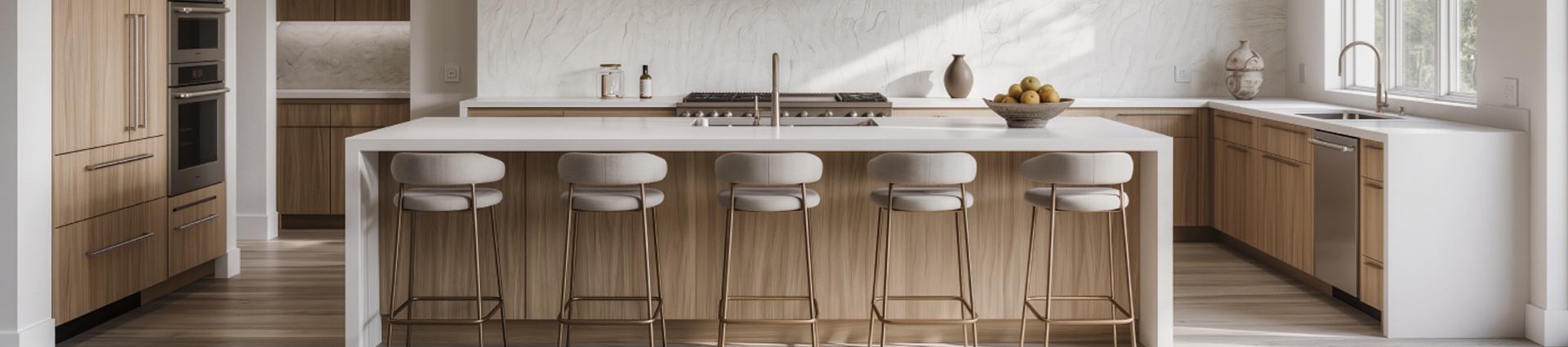
Returns rarely start with packaging alone. In seating, they usually start with a mismatch between what people expect and what they feel after daily use. A chair may look right in a catalog, but if the frame flexes, the seat edge presses the legs, or the backrest fails to support the body well, complaints arrive quickly. That is why lowering return rate begins with structure engineering and comfort design, not only with appearance.
The pressure on retailers is real. The National Retail Federation estimated that 16.9% of annual retail sales in 2024 would be returned, totaling about $890 billion. It also reported that 67% of consumers say a negative return experience would discourage them from shopping again. For furniture sellers, every preventable comfort complaint matters because returns do not only increase cost, they also weaken repeat business.
Meet U Furniture is based in Longjiang, Shunde, one of China’s best-known furniture manufacturing areas. For a maker focused on bar stools, Bar Tables, Dining Chairs, Leisure Chairs, and Home Office Chairs, this matters because practical product development comes from repeated testing of frame balance, sitting posture, material matching, and production consistency. A reliable durable bar chairs supplier does not treat return reduction as an after-sales issue. It solves it before mass production.
The first reason many bar chairs are returned is simple: they feel unstable. In tall seating, even a small amount of looseness is magnified because the center of gravity is higher than in standard dining chairs. Buyers notice wobble quickly, especially in commercial settings with repeated movement.
A good design process should focus on frame geometry, weld consistency, joint reinforcement, and weight distribution. Swivel models need even more attention because the rotating mechanism introduces another point of wear. If the plate, bearing, or fixing screws are not matched well, the chair may develop noise, play, or tilt after repeated use. This is especially important for bar stools padded swivel designs, where soft seating comfort must be supported by a strong internal structure.
BIFMA seating standards exist for exactly this reason. BIFMA states that ANSI BIFMA X5.4 covers seating used in indoor public spaces such as waiting, reception, and visitor seating, while its occasional-use seating standards use tests based on the 95th percentile male at 275 lb. That gives manufacturers a clear benchmark for strength, durability, and safety validation before products reach the market.
Comfort is not only about thicker foam. In many returned chairs, the real issue is dimensional mismatch. Cornell ergonomic guidance notes that fixed seat depth is best around 16.5 in, or 41.9 cm, while seat width around 20 to 22 in helps accommodate clothed users more comfortably. It also explains that a seat that is too high increases pressure below the knees, while a seat that is too low concentrates pressure on the sitting bones.
OSHA gives similar guidance. It recommends a rounded waterfall front edge, enough seat width for most users, and a seat pan depth that supports most of the thigh without touching the back of the knee. OSHA also notes that unsupported feet and poor seat height can lead to fatigue, restricted circulation, swelling, numbness, and pain.
For bar chairs, these points are even more critical because seat height is elevated. If the chair is tall but the foot support is weak or wrongly placed, the user feels pressure faster. That discomfort may appear within minutes, and that is often enough to trigger a complaint.
| Design area | What to control | Why it lowers returns |
|---|---|---|
| Frame stability | Base balance, weld quality, joint strength, anti-wobble structure | Reduces shaking, noise, and early looseness |
| Swivel system | Bearing quality, plate thickness, screw locking accuracy | Prevents tilt, friction noise, and uneven rotation |
| Seat comfort | Proper foam density, rounded front edge, supportive seat depth | Reduces leg pressure and short-term discomfort |
| Back support | Backrest height, angle, lumbar contact, width | Improves sitting posture and perceived quality |
| Foot support | Strong footrest position and load resistance | Helps users sit longer with less fatigue |
| Size matching | Correct seat height and body proportion fit | Reduces complaints about awkward sitting posture |
Many return problems can be found during internal evaluation. OSHA purchasing guidance recommends seat height adjustment from 15 to 22 in, seat pan length from 15 to 17 in, minimum seat width of about 18 in, backrest height of at least 17.7 in above the compressed seat pan, and armrest spacing of at least 16 in when armrests are used. Even though bar chairs are a different category from office seating, these human-factor references are highly useful when checking whether a chair supports the body well across different users.
For manufacturers, that means three checkpoints should never be skipped:
Use people of different heights to test entry, sitting balance, foot placement, back contact, and exit motion. A chair that photographs well may still feel tiring after ten minutes.
Swivel chairs should be tested for repeated turning, leaning, and side loading. A return often happens after small movement defects become obvious in real use.
Even strong chairs can arrive loose if packaging allows rubbing, leg pressure, or hardware movement during transport.
Meet U develops and manufactures within a strong furniture production region, which supports faster sampling, detail adjustment, and more practical quality control. That matters in projects where appearance, durability, and comfort must stay balanced across multiple units. A true high quality seating solution is not created by adding more foam alone. It comes from the right frame, the right dimensions, and repeatable manufacturing.
When buyers choose a durable bar chairs supplier, they are not only buying a chair. They are buying fewer complaints, better user feedback, and more stable sell-through. In bar chair production, return rate drops when structure stays firm, comfort feels natural, and every detail is checked before the container leaves the factory.
Share models, materials, quantity and timeline. We reply within 24 hours.


Monday - Friday: 9:00 AM - 6:00 PM (CST)
Saturday: 9:00 AM - 12:00 PM
Sunday: Closed