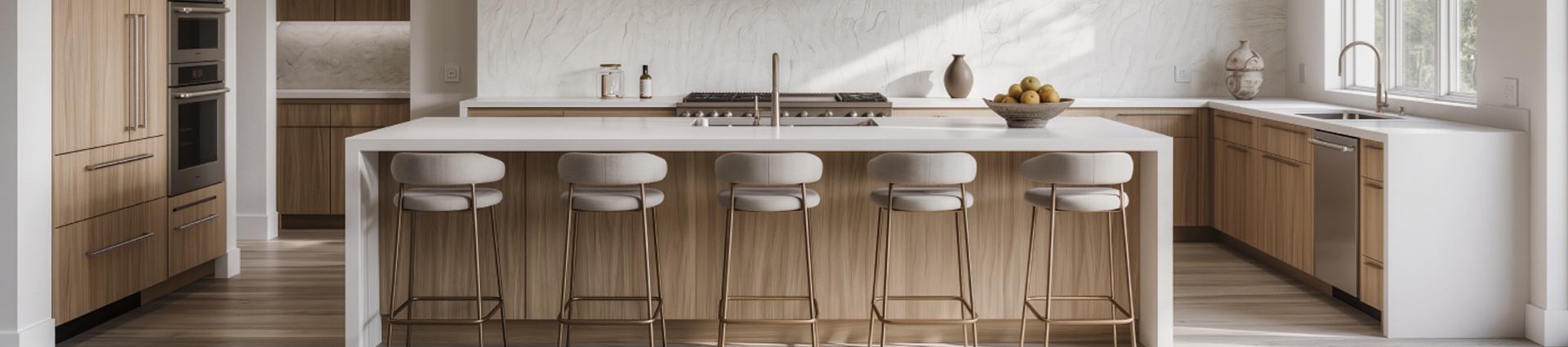
Restaurant seating has shifted from purely functional layouts to experience-driven design. Among many seating options, swivel bar stools have become increasingly common across cafés, casual dining, and hospitality venues. This trend is not accidental. It reflects how restaurants balance space efficiency, customer comfort, and operational flow. Understanding why restaurant swivel chairs are widely adopted helps buyers align product selection with real usage conditions.
Modern dining environments are no longer just about eating. Customers expect flexibility, comfort, and a more social atmosphere. Industry data from the National Restaurant Association shows that customer experience and comfort are key drivers in repeat visits and overall satisfaction. Seating design plays a direct role in this.
Swivel stools support this shift by allowing users to move naturally without repositioning the entire chair. This small functional detail significantly improves how people interact within the space.
Restaurants often operate within limited floor areas. Every seat must contribute to both capacity and usability. Swivel stools allow guests to enter and exit seats more easily, especially in tighter layouts.
Instead of pulling the stool backward, users can rotate and step down smoothly. This reduces congestion around counters and bar areas. For operators, this improves traffic flow during peak hours and helps maintain a cleaner, more organized layout.
This is why many modern restaurant seating solutions integrate swivel mechanisms, especially in bar counters and high tables.
Dining is a social activity. Seating that supports interaction naturally enhances the experience. Swivel stools allow guests to turn toward companions, staff, or different areas of the space without effort.
This becomes particularly valuable in open kitchens, bar counters, and casual dining setups where communication between guests and staff is part of the experience. The ability to rotate adds flexibility that fixed seating cannot provide.
Products such as swivel bar chairs with backs further improve this interaction by combining support with movement, making them suitable for longer seating durations.
Comfort directly affects how long customers stay and how they perceive the space. Upholstered swivel stools, especially those with backrests, provide better support compared to basic fixed stools.
Industry seating studies show that ergonomic support and ease of movement contribute to longer seating time and higher customer satisfaction. Swivel stools reduce the need for constant repositioning, which helps users feel more relaxed.
For restaurants that aim to create a more premium or lounge-like atmosphere, this type of seating becomes a practical choice rather than a decorative one.
Swivel stools do not only benefit customers. They also improve daily operations.
Easier cleaning access around seating areas
Reduced need to move heavy stools frequently
Better alignment with fixed counter layouts
Less disruption during busy service periods
When stools remain in position and users adjust themselves instead, staff can maintain the layout more efficiently. This contributes to smoother service and reduced labor effort.
Swivel stools are available in a wide range of materials and finishes, from metal frames to upholstered seats. This allows designers to match seating with different restaurant concepts, from industrial to modern to casual dining.
The addition of a swivel function does not limit design options. Instead, it enhances the usability of visually appealing seating.
For manufacturers like Meet U Furniture, this flexibility means offering multiple configurations such as fixed, 180° memory swivel, and 360° swivel options within the same product line. This helps buyers maintain design consistency while adapting to different functional needs.
One concern with swivel stools is durability. Compared to fixed stools, swivel mechanisms require higher manufacturing precision and quality control.
Industry standards such as BIFMA testing evaluate seating for strength, stability, and fatigue resistance under repeated use. High-quality swivel stools must pass both structural and mechanical testing to ensure long-term performance.
When properly manufactured, swivel stools can perform reliably even in high-traffic environments. The key factor is not the presence of movement, but the quality of the mechanism and materials used.
The popularity of swivel bar stools reflects broader changes in restaurant design:
More open and interactive layouts
Increased focus on customer comfort
Higher expectations for flexible seating
Need for efficient space utilization
As restaurants continue to evolve, seating will remain a critical part of the overall experience. Swivel stools offer a practical balance between function and comfort, making them a long-term solution rather than a passing trend.
Swivel bar stools are not just a design upgrade. They are a response to how restaurants operate today. By improving movement, comfort, and interaction, they support both customer experience and operational efficiency. This is why restaurant swivel chairs and similar seating options have become a standard choice in modern restaurant environments.
Share models, materials, quantity and timeline. We reply within 24 hours.


Monday - Friday: 9:00 AM - 6:00 PM (CST)
Saturday: 9:00 AM - 12:00 PM
Sunday: Closed