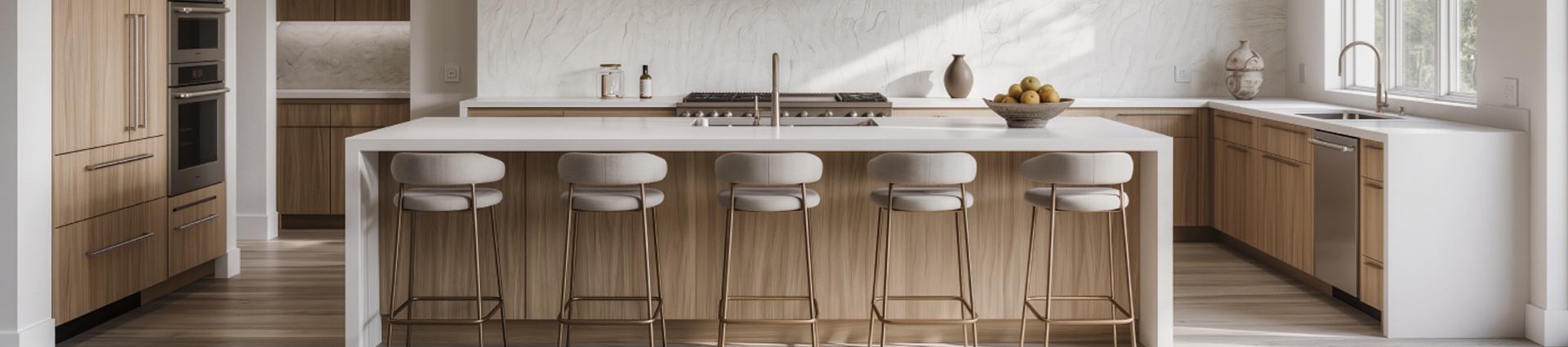
Choosing between swivel and fixed bar stools is not only a style decision. It directly affects durability, user experience, maintenance cost, and long-term performance in real environments. A clear understanding of swivel vs fixed bar stools helps buyers avoid mismatched specifications and improve overall seating efficiency.
From a manufacturer’s perspective, the right structure should always match how the stool will be used, how often it will be moved, and how much load it will handle over time.
Swivel bar stools are designed with a rotating mechanism, usually allowing 180° or 360° movement. This improves flexibility, especially in tight spaces or social environments where users need to turn without moving the base. In contrast, fixed stools have a static structure with no moving parts, offering higher stability and simpler construction.
According to seating durability references aligned with BIFMA standards, chairs with fewer moving components generally show lower long-term failure rates under repeated use. This explains why fixed stools are often preferred in high-frequency environments.
Fixed stools are widely used in projects that prioritize durability, cost control, and easy maintenance. They are suitable for restaurants, fast-paced cafés, food courts, and large-scale commercial installations.
Key advantages include:
Higher structural stability Without rotating parts, the frame maintains consistent load distribution, reducing wear over time.
Lower maintenance requirements No swivel mechanism means fewer components that may loosen or require adjustment.
Better cost efficiency for large orders Many buyers sourcing through fixed bar stools wholesale programs prefer this option for consistent pricing and simplified production.
Easier cleaning and repositioning Fixed bases are less likely to shift unexpectedly, which helps in organized seating layouts.
For environments with constant traffic and quick turnover, fixed stools provide a more predictable and controlled seating solution.
Swivel stools are designed to improve user convenience and comfort, especially in spaces where interaction and flexibility are important. They are commonly used in bars, lounges, premium retail areas, and residential-style settings.
Key advantages include:
Improved accessibility Users can rotate instead of moving the entire stool, which is useful in tighter layouts.
Enhanced user comfort The ability to turn reduces strain when entering or exiting the seat.
Better fit for social environments In hospitality settings, rotation supports conversation and engagement.
Premium positioning Many swivel bar height stools are selected for projects that aim for a more refined or relaxed atmosphere.
However, swivel structures require stricter quality control. The rotation mechanism must be tested for durability, smooth movement, and noise control. Inconsistent mechanisms can affect user experience and shorten product lifespan.
For both types, durability should not be judged by appearance alone. Buyers should confirm:
Frame material thickness and welding quality
Load capacity under repeated use
Surface coating resistance to scratches and cleaning agents
Stability under uneven load conditions
Industry testing systems such as BIFMA standards evaluate seating for strength, stability, and fatigue resistance under repeated cycles. These references show that structural integrity and material consistency are critical for long-term performance.
In swivel stools, additional testing is needed for the rotation mechanism, including cycle testing and joint stability.
Cost differences between swivel and fixed stools are not only about unit price. They also include maintenance, replacement frequency, and installation considerations.
| Factor | Fixed Stools | Swivel Stools |
|---|---|---|
| Initial cost | Lower | Higher |
| Maintenance | Minimal | Moderate |
| Durability | Very stable | Depends on mechanism quality |
| User flexibility | Limited | High |
| Suitable environments | High-traffic, functional | Social, premium, flexible |
For large-scale projects, fixed stools often provide better cost control and easier standardization. For smaller or design-driven spaces, swivel stools can enhance user experience and perceived value.
Meet U Furniture, located in Longjiang, Shunde, operates within one of China’s most established furniture manufacturing hubs. This allows efficient coordination of materials, finishes, and production processes across bar stools, dining seating, and related categories.
For buyers, this means:
Consistent quality across different structures
Flexible options including fixed, 180° memory swivel, and 360° swivel
Stable production capacity for bulk orders
Matching designs across multiple product lines
Instead of choosing between style and function, buyers can align structure, material, and application within one sourcing system.
There is no single best option between swivel and fixed stools. The decision depends on how the space will be used, how often the seating will be occupied, and how much maintenance the project can support.
Fixed stools offer reliability and efficiency. Swivel stools offer flexibility and comfort. A clear evaluation of swivel vs fixed bar stools ensures that the final selection supports both performance and user experience over time.
Share models, materials, quantity and timeline. We reply within 24 hours.


Monday - Friday: 9:00 AM - 6:00 PM (CST)
Saturday: 9:00 AM - 12:00 PM
Sunday: Closed