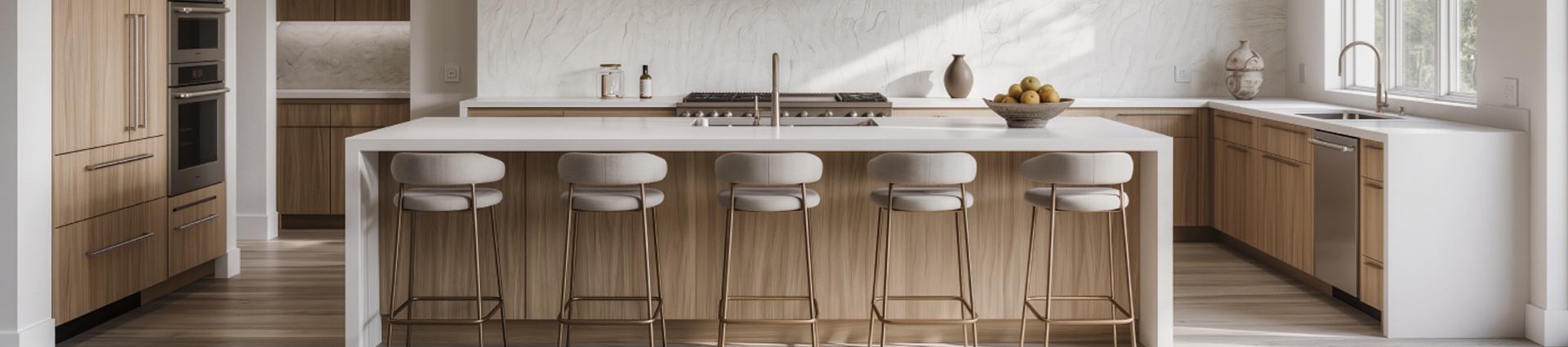
Wobbling is especially noticeable on elevated seating because a small amount of movement at the base becomes more pronounced at seat level. Uneven legs, loose fasteners, weak welds and unsuitable floor glides are frequent causes. Stable performance depends on accurate frame geometry and consistent assembly rather than simply increasing the weight of the stool.
All contact points should reach a level floor at the same time. If one leg is shorter, twisted or welded at a slightly different angle, the stool can rock diagonally.
Fixtures and jigs help maintain consistent leg spacing and frame alignment during welding. After the frame cools, it should be checked again because heat can produce distortion. These controls are particularly important for metal frame bar stools, where small dimensional differences can affect the entire structure.
A sufficiently wide footprint also improves stability. However, an oversized base may obstruct walkways or interfere with adjacent stools, so base dimensions should be coordinated with seat height and overall width.
A frame may initially stand level but develop movement when joints begin to flex. Welds should have adequate penetration and consistent placement without cracks, gaps or excessive grinding.
Knock-down designs depend on bolts and threaded inserts. Incorrect torque, missing washers or poorly aligned holes can leave small gaps between components. Hardware should be tightened according to a controlled assembly sequence and checked again after the stool has been loaded.
Swivel models require additional attention. Movement between the seat plate, swivel mechanism and lower frame can feel like frame wobble even when the legs are level.
Floor glides compensate for minor surface variation and protect both the frame and flooring. They must fit securely and remain level after installation.
Adjustable glides work well on uneven commercial floors, but users or installers need clear setup instructions. Fixed plastic glides are simpler, although damaged or partially inserted pieces can create height differences.
The flooring itself should also be examined. A stool that rocks on irregular tile joints may remain stable on a flat test platform.
Static inspection does not show how a stool behaves when someone gets on, rotates or leans against the backrest. Samples should be assessed under vertical, rearward and lateral forces.
The following checkpoints support stable bar stool construction:
Equal contact at every leg or base point
Consistent diagonal frame measurements
Secure welds and fasteners
Suitable base width for the seat height
Correctly fitted floor glides
Minimal play in swivel connections
No permanent distortion after loading
Meet U can inspect frame alignment and stool balance at key production stages. Checking only completed cartons makes correction more difficult because instability may originate during tube cutting, welding or component assembly.
| Production Stage | Recommended Check |
|---|---|
| Tube preparation | Length and cutting angle |
| Welding | Fixture alignment and joint quality |
| Surface finishing | Frame distortion and coating buildup |
| Assembly | Fastener torque and mechanism fit |
| Final inspection | Level-floor rocking test |
| Sample testing | Static and repeated loading |
A reliable heavy duty stool supplier should define acceptable movement and inspection methods before bulk production. Consistent measurements, controlled joints and final floor testing provide a more dependable solution than attempting to correct wobble after delivery.
Share models, materials, quantity and timeline. We reply within 24 hours.


Monday - Friday: 9:00 AM - 6:00 PM (CST)
Saturday: 9:00 AM - 12:00 PM
Sunday: Closed