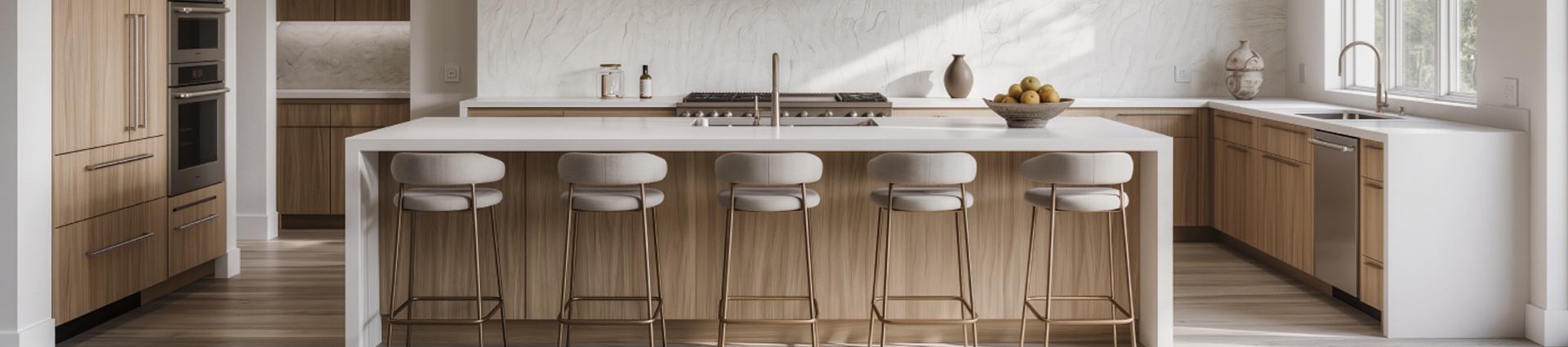
Selecting bar stools for a commercial space is not only about style. The right choice affects comfort, layout efficiency, cleaning speed, maintenance cost, and how consistently the space performs over time. A good bar stools selection guide starts with measurements, but it should end with durability, finish control, and supplier support. For commercial and retail environments, that combination matters far more than trend alone.
Meet U Furniture is based in Longjiang, Shunde, one of China’s best-known furniture manufacturing clusters. That location matters in practical terms. It supports faster material coordination, broader style development, and more efficient production for bar stools, Bar Tables, dining seating, Leisure Chairs, and Home Office Chairs. From a manufacturer’s view, the goal is not just to offer more models, but to help buyers match the right seat height, structure, and finish to the real use condition of each space.
The first step is always the surface height, not the stool itself. Accessible dining and work surfaces under ADA guidance are set at 28 to 34 inches high. In mainstream commercial planning, counter stools are commonly used with surfaces around 34 to 36 inches, while bar stools are commonly paired with bars around 40 to 42 inches. Many commercial sizing guides also recommend leaving about 10 to 12 inches between the seat and the underside of the counter for comfortable legroom.
That means a project team should confirm the final installed counter height before approving production. A stool that looks correct in a sample room can feel wrong on site if the countertop specification changes by even a small amount. This is one reason experienced factories usually ask for layout drawings, top height, and target seat height before confirming a bulk order.
Below is a practical sizing reference that works well for most hospitality, retail, and mixed-use interiors. The exact model can still vary by seat shape and cushion thickness, but the range gives a reliable starting point.
| Surface type | Surface height | Suggested seat height | Typical use |
|---|---|---|---|
| Dining table | 28 to 30 in | 17 to 19 in | cafés, waiting areas, casual dining |
| Counter | 34 to 36 in | 24 to 28 in | cafés, bakeries, retail counters, islands |
| Bar | 40 to 42 in | 28 to 32 in | bars, lounge zones, hospitality venues |
A reliable commercial bar stools buying guide should also account for cushion compression. Soft upholstered seats can sit lower after repeated use, so the seat height on paper should be checked against the actual sitting feel during sample review.
Many buying mistakes happen because teams focus on the number of stools first and user comfort second. Commercial layout guides commonly recommend allowing about 24 inches of width per stool. Another common rule is one stool for every 2 feet of bar length. For center-to-center spacing, 26 to 30 inches is a useful range, especially when the design includes backs, arms, or swivel movement.
This matters even more in high-traffic venues. Overcrowding may increase seat count on paper, but it reduces comfort, slows entry and exit, and makes the bar line look tight. In retail or foodservice settings, a better layout often performs more smoothly than a denser one.
For public-facing spaces, accessibility should be reviewed at the same time as style. ADA requirements state that accessible dining and work surfaces should be 28 to 34 inches high. Knee clearance should provide at least 27 inches of height, with a minimum width of 30 inches. Where knee and toe depth exceeds 17 inches, the additional depth should maintain full knee clearance at 27 inches high. (ADA.gov)
This does not mean every stool area must follow the same detail, but it does mean the overall seating plan should leave accessible positions where required. Manufacturers that understand commercial use can coordinate stool dimensions with table bases, overhang depth, and accessible seating zones more effectively.
The next decision is structural. Fixed stools are usually the safer choice for dense commercial traffic because they are simple, stable, and easier to maintain. Swivel stools improve user convenience and can support a more relaxed seating experience, but they require tighter quality control on mechanism durability and assembly consistency.
This is where supplier capability becomes important. Buyers should ask whether the stool has been developed with reference to applicable ANSI and BIFMA seating standards, since BIFMA maintains standards covering general purpose chairs and public or lounge seating performance. In practical sourcing, this is a strong signal that the factory understands durability expectations beyond appearance alone. (BIFMA)
Meet U’s advantage here is product focus. A factory that works continuously on stools, dining seating, and related furniture categories is usually better prepared to advise on frame structure, seat balance, finish matching, and repeat-order consistency.
Commercial bar stools are touched, moved, and cleaned far more often than residential ones. The right material choice depends on how the site is maintained every day.
Upholstered seats support a warmer look and better perceived comfort, especially in dining and lounge spaces.
Easy-clean surfaces are more practical for foodservice and high-turnover environments.
Metal frames can support an industrial or modern direction and often perform well in frequent-use settings.
Wood-look finishes help soften the space visually, but the coating system should be checked for scratch resistance and batch consistency.
From a manufacturing perspective, the finish is not a small detail. On a bulk order, the buyer should confirm color tolerance, sheen consistency, weld finishing, footrest protection, and packaging method before production starts. This is exactly where working with a responsive bulk bar stools supplier reduces risk.
Before placing an order, buyers should confirm these points with the factory:
What final seat height is recommended for the actual counter or bar
Is the model fixed, swivel, or memory-return
What is the frame material and finish process
How is the seat surface tested for repeated use and cleaning
Can the factory keep finish consistency across repeat orders
What dimensions and carton loading will affect freight cost
Can the same series be extended into Dining Chairs or matching tables
These questions help turn a catalog choice into a working specification.
Meet U Furniture combines manufacturing experience with category focus in bar stools, bar tables, dining seating, leisure chairs, and home office chairs. That makes it easier to build collections that feel consistent across a project, not just single items that look good in isolation. For buyers handling commercial rollout or retail programs, that consistency is often what protects timelines and reduces replacement trouble later.
The best bar stool choice is the one that fits the finished height, the traffic pattern, the cleaning routine, and the long-term reorder plan from the very beginning.
Previous: What Height Bar Stool Should You Choose?
Next:
Share models, materials, quantity and timeline. We reply within 24 hours.


Monday - Friday: 9:00 AM - 6:00 PM (CST)
Saturday: 9:00 AM - 12:00 PM
Sunday: Closed